
Neurostrength: 1286 Professionals On Building a Career When Your Brain is Wired Differently
How do people like us—those with anxiety, depression, ADHD, OCD, autism, bipolar, learning differences, or simply brains that don’t fit the mold—actually experience work? After decades writing, podcasting, coaching, and consulting with such people I’d logged many common threads, plus 27 years of “me-search” based on my own experience. But because I’m writing a book about this stuff, I wanted some quantitative data and so I embarked on what I call the “Neurostrength Survey” in February 2025.
The response was amazing. 1,286 of you finished the survey. 500 more of you gave me your email and said, “I want to talk more about this!” I spoke with about 50 people in 3 focus groups. And, well, you confirmed my hunches.
The survey analysis is available for you today, for free. Click here. You can listen to the companion podcast here. Some highlights:
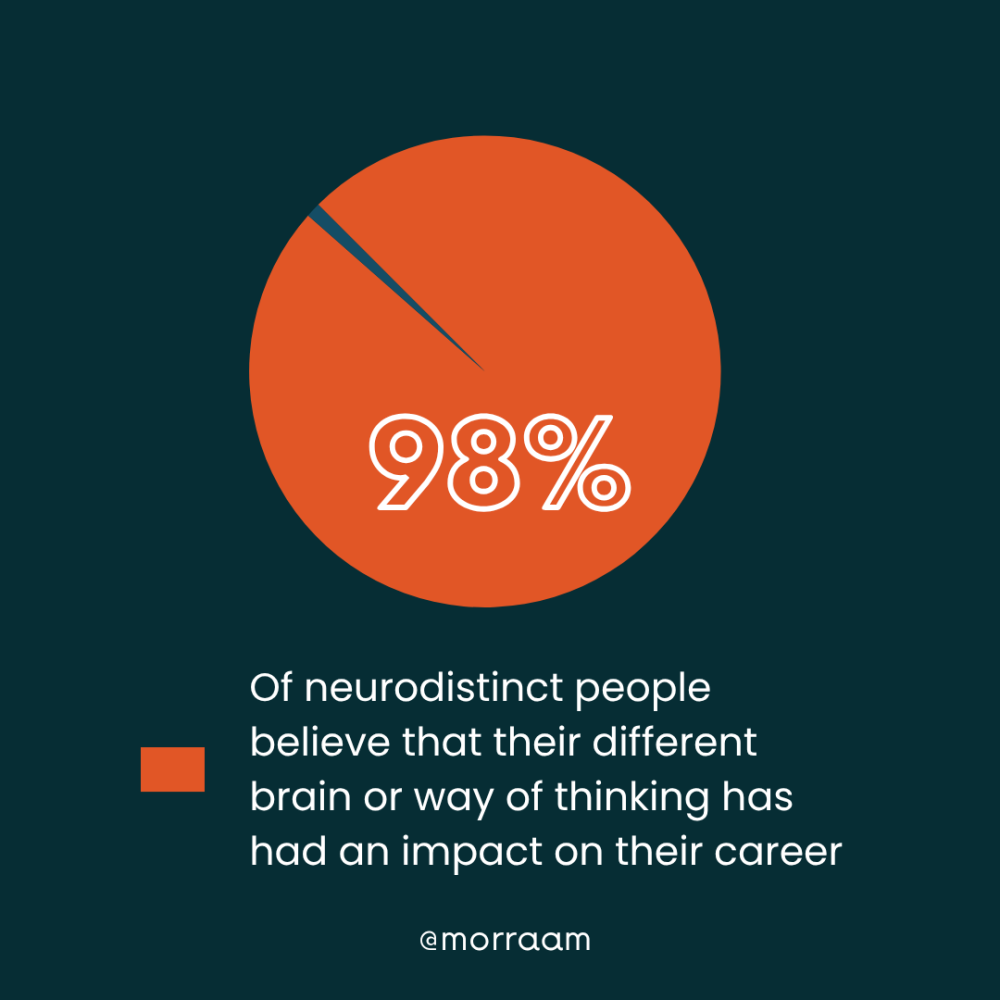
98% of respondents said their “different brain” has influenced their career.
91% believe their different brain gives them abilities in performing specific tasks that have been useful and helpful in their career.
64% described the impact of their different brain as complex, not purely positive or negative. Those who see their brain as a source of useful abilities are more likely to report positive career impact.
67% identify as “neurodivergent” or “neurodistinct,” and many who manage mental illness do not identify as such even though they share characteristics with those who do.
75% of all respondents believe their brain gives them “superpowers.” (Among those identifying as neurodivergent/neurodistinct, this rises to 80%.)
What helps them thrive at work? Flexibility, tools and strategies, and manager support.
Only 11% have formally disclosed to their employer that they’re neurodistinct, while 30% have “informally” told colleagues at work.
In the conversations and in the hundreds of comments you left in the survey, I heard pride and success right alongside fatigue from trying to fit into systems that weren’t built for you.
That complexity shows up most starkly in relationships and unwritten rules. One participant told me, “I’m sometimes more honest than people expect. After years of masking, I choose not to anymore. Some people find it threatening; others feel permission to be themselves.” I heard variations on: “When people want new thinking and innovative ideas, they bring me in, but they don’t always want that.” Another recounted a hiring practice that required every candidate to meet the CEO: “Someone once didn’t look the CEO in the eye,” the recruiting team said. “So we don’t want anyone autistic here?” replied the Neurostrength participant. People are using their voices to challenge norms that quietly screen out talent, but they’re also realistic about the risks when authenticity meets stereotypes, status quo, and hierarchy, especially in the current job market.
There’s a dual reality I heard again and again: excellence at one’s craft paired with friction in the office environment. “I gave up trying to be a manager, too much politics and reading between the lines” one respondent said. “I’m a better practitioner than a manager. Working for myself unlocked a lifestyle business I actually like,” said another, and indeed, 19% of the sample are self-employed, compared to about 10% of the general population.
Another participant described the emotional math of leadership with generalized anxiety: highly competent, hyper-organized, and yet “conflict aversion makes feedback terrifying,” to the point that he needed a beta-blocker before a layoff conversation just to get the words out. Some with ADHD noted they were perceived as unserious, overly passionate, or lost interest when novelty wore out, which alienated colleagues. Many said they struggle with relationship misalignments and the cost of masking; in our survey, 90% of neurodistinct respondents reported difficulties in work relationships.
And yet, most also described what they consider superpowers, even those who dislike the term. Seventy-five percent of all respondents, and 80% who identify as neurodistinct, told us their brains give them a competitive edge. The strengths they named are strikingly consistent: creativity and innovative thinking, pattern recognition, lateral thinking, hyperfocus, quick learning, strategic sense-making, empathy and perception, and an uncommon persistence when they care about the work. “I can hear people talk about a problem and I’m five steps ahead,” one person said. “I’m usually right.” Another added, “When I can hyperfocus, I get things done three times as fast—and then I’m given more. I’ve harnessed that to advance my career.” A founder who rejects the superhero framing put it simply: “I don’t use the word superpower. I have traits. Pattern recognition and lateral thinking are intuitive—I didn’t notice until others pointed it out.”
Of course, the same traits that drive innovation can create everyday friction. Many participants spoke about sensory overload and the emotional drain of “passing.” Others described procrastination on boring or repetitive tasks, disorganization, or perfectionism that makes starting—and finishing—harder than it looks from the outside. “I’m constantly told I’m a very good writer,” one woman said. “But initiating is brutal. My hyperactivity is in my mind—I have so many thoughts, and perfectionism fights the first draft.” Another added, “I had to relearn a humane approach. I operate like: everyone should be as devoted as I am. Patience didn’t come naturally.”
The hopeful throughline is how people have learned to build work around their brains instead of against them. In the data, the top supports were flexibility (65%), a supportive manager (54%), and organizational/scheduling tools (35%). In practice, people built whole ecosystems for focus, recovery, and scaffolding. Routines and movement were common anchors: a daily walk at 10 a.m. and again at 3 p.m., rain or shine, because “if I skip, I feel it the next day.” Exercise four to five times per week came up frequently, as did “hardest tasks in the morning” and small resets when strategies slip: “When things fall apart, I go back to morning routines, meditation, and getting outside.”
Tools matter, too. Several spoke about “chunking” work—one executive swears by Outlook categories to group emails by topic so she can hyperfocus and clear entire threads at once. “If a company only uses Gmail, I’m out,” she joked. Others described AI as a quiet game-changer for routine tasks, from rewording boilerplate to building multi-step checklists and organizing process flows. Dictation came up as a bridge between thought and text: “I write like I speak; if I can talk the draft, I can edit it into shape.”
The results are linked for you to review, for free. A huge thank you to everyone who participated in the survey, to Farrah Bostic, market research superstar (could not have done this without you), and to Dr. Garrett Morrow and Diane Biray Gregorio, Ph.D. for analyzing the story in the data.
I welcome any questions, and if you’d like to access the full data set, please send me a message.
Morra
P.S.: Last night in London, the amazing Ludmila Praslova, Ph.D., SHRM-SCP, Âû won the Thinkers50 Talent Award for her book, The Canary Code: A Guide to Neurodiversity, Dignity, and Intersectional Belonging at Work. It’s a wonderful book for anyone who wants to understand how to create workplaces that grows and supports the potential of everyone.